
All-Terrain vs. Mud-Terrain Tires: Which Fits Your Truck?
All-terrain and mud-terrain tires both leave the pavement, but they trade noise, wear and grip very differently. Here is how to pick the right one.
Quick answer
- If most of your miles are on pavement, with some gravel, snow or easy trails, an all-terrain tire is the better fit.
- If you regularly drive in deep mud, clay or rough rocky trails and can live with more road noise and faster wear, a mud-terrain makes sense.
- Somewhere in between? A rugged-terrain (hybrid) tire splits the difference.
- Whatever tread you pick, start from the size on your door-jamb placard and make sure the new tires can carry at least as much load as the originals.
Walk past a row of pickups and you will see two kinds of off-road tires: the tidy, blocky all-terrain and the chunky, wide-gapped mud-terrain. Both look tough and both can leave the pavement. But they are built for different jobs, and picking the wrong one can mean a noisy commute, tires that wear out early, or getting stuck on the one trail you care about. Here is how to choose.
The real difference is in the tread
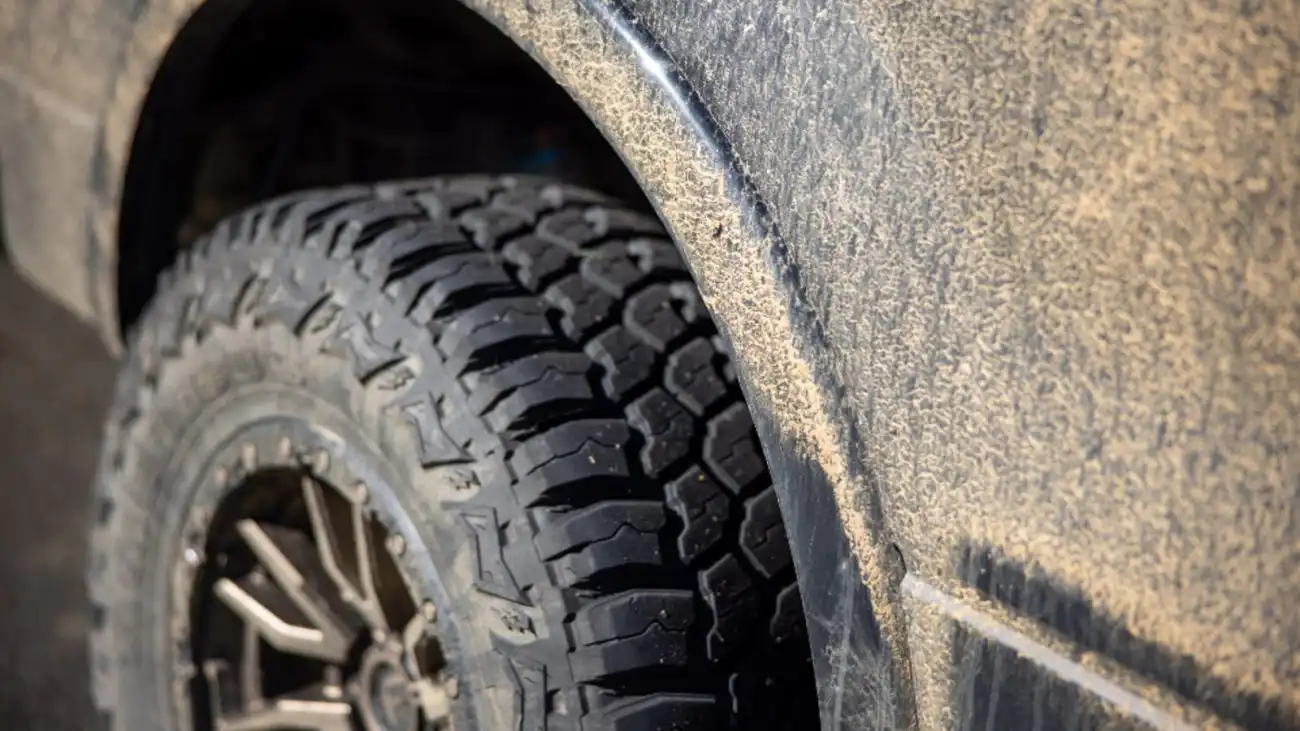
An all-terrain tire (A/T) packs its tread blocks fairly close together. Those blocks are usually cut with many sipes, the thin slits you see across the rubber. Sipes add biting edges, which helps on wet roads and in snow. The whole design is a compromise: enough grip for dirt and gravel, calm enough for daily driving.
A mud-terrain tire (M/T) goes the other way. It uses fewer, larger blocks with wide open channels, called voids, between them. Those voids let mud, sand and loose soil squeeze out as the tire turns, so the tread keeps cleaning itself instead of packing up into a slick drum. Many mud-terrains also wrap aggressive lugs onto the upper sidewall for extra bite in ruts and on rocks, and they generally have fewer sipes than an all-terrain.
On the road: noise, ride, wet grip and wear
This is where most owners feel the difference, because most trucks spend most of their time on pavement.
- Noise. Big blocks with big gaps hum and roar at highway speed. An all-terrain is usually much quieter.
- Wet pavement. With fewer sipes, a mud-terrain has fewer edges to grip a wet road. Leave extra following distance in the rain.
- Tread life. Tire makers generally agree that an all-terrain outlasts a mud-terrain. Open, blocky lugs wear faster on hard roads.
- Fuel use. Aggressive mud-terrains tend to cost some fuel economy compared with an all-terrain of the same size.
One shopping tip: the treadwear grade you may know from car tires (part of the UTQG grades on the sidewall) is a federal grading system for passenger car tires. Many all-terrain and mud-terrain tires are sold in LT, or light truck, sizes that are not graded that way. For those, check the product details for a mileage warranty, and do not be surprised if some mud-terrains have none.
Off the pavement: where each one earns its keep
Mud and clay. This is home turf for the mud-terrain. The open tread clears itself and keeps finding fresh grip. An all-terrain’s tighter pattern can fill with mud and turn slick.
Gravel, dirt roads and ranch tracks. An all-terrain handles these well, and it is the more pleasant tire on the drive there and back.
Sand and snow. Off-road guides from tire makers often favor the all-terrain for sand. In snow, its tighter tread is less likely to pack up, and its extra sipes add biting edges. More on snow below.
Rocks. It depends on the rock. On grippy, solid rock an all-terrain can do fine. On broken, mixed terrain with loose dirt, the big lugs and sidewall blocks of a mud-terrain help. Either way, a tough sidewall matters when the edges are sharp.
Many off-roaders let some air out on the trail for a bigger footprint. The U.S. Tire Manufacturers Association (USTMA) says normal highway pressure suits most off-road driving, and that if you lower pressure for extra traction at low speeds, you must re-inflate before you drive on the highway or at higher speeds again. Going too low can also unseat a tire from the wheel. Carry an accurate gauge and a compressor, and look the tires over for cuts after a rough day.
Snow: read the sidewall symbols
You will see M+S (mud and snow) on many all-terrain and mud-terrain tires. That mark is based on tread geometry, meaning the shape and amount of open space in the tread. It does not require a snow test.
The three-peak mountain snowflake (3PMSF) symbol means more. To earn it, a tire must score at least 10 to 12 percent better than a standard reference tire, depending on which reference tire is used, in a standardized traction test on medium-packed snow. A number of all-terrain tires from major makers now carry the symbol. Many mud-terrains carry only M+S, so check each tire’s details if winter traction matters to you.
Know the limits, though. The 3PMSF rating is based on a packed-snow traction test, so it tells you nothing about grip on ice. If you face long stretches of icy roads, a dedicated winter tire is still the specialist. Our comparison of winter tires and all-season tires explains why rubber compound matters so much in the cold.
Rugged-terrain: the middle ground
If you cannot decide, look at rugged-terrain tires, often called hybrids. Their tread is more open and aggressive than an all-terrain’s but less so than a full mud-terrain’s. The idea is to gain trail bite in loose dirt and light mud while giving up less highway quietness and tread life than a mud-terrain would. They suit drivers who hit trails regularly, like the aggressive look, and still commute on the highway every week.
Load range and size: get these right first
Tread style is a preference. Size and load capacity are not. Start with the tire placard on the driver’s door jamb, or your owner’s manual. It lists the original tire size and the cold inflation pressures.
- Load range. Many all-terrain and mud-terrain tires come in light truck sizes with a load range letter: C, D, E or F. Each step up allows a higher maximum pressure and more carrying capacity. A higher load range is not automatically better. It can ride stiffer, and it only carries its rated load at the right pressure. Your new tires must be able to carry at least as much load as the originals. If you change tire type, for example from a passenger (P-metric) size to an LT size, the pressure needed to do that can change, so have your installer check the load tables.
- Size changes. Taller or wider tires need clearance checks at full steering lock and full suspension travel. A different overall diameter can also throw off the speedometer and some electronic systems. Lift kits and oversize tires can change handling, so talk to a qualified tire shop before you upsize.
- Buy a matched set. Unless your owner’s manual says otherwise, USTMA guidance for 4WD and AWD vehicles is to run four tires of the same size and not to mix tread pattern types. Do not put mud-terrains on one axle and all-terrains on the other.
A simple way to decide
The table below sums up the general trade-offs. Individual tires vary, so treat it as a starting point.
| Feature | All-terrain | Rugged-terrain | Mud-terrain |
|---|---|---|---|
| Tread design | Tighter blocks, many sipes | More open blocks, bigger shoulders | Large blocks, wide voids, sidewall lugs |
| Highway noise | Usually lowest | In between | Usually highest |
| Wet pavement grip | Usually best of the three | In between | Usually weakest (fewer sipes) |
| Tread life on pavement | Usually longest | In between | Usually shortest |
| Deep mud | Can pack up | Moderate | Strongest, self-cleaning tread |
| Winter marking | M+S; some also 3PMSF | Varies by tire | Often M+S only |
| Best for | Mostly pavement, some off-road | Regular trails plus commuting | Frequent mud, clay or rock trails |
- Estimate how your driving splits between pavement and dirt. Be honest; this is the biggest factor.
- If pavement is the clear majority and your off-road time is gravel, dirt roads, snow or easy trails, choose an all-terrain.
- If you regularly face deep mud or technical trails and accept the on-road trade-offs, choose a mud-terrain.
- If you land in the middle, shortlist rugged-terrain options.
- If you drive in snow, favor tires that carry the 3PMSF symbol.
- Confirm size, load capacity and speed rating against your placard and owner’s manual.
When you have narrowed it down, shop by your tire size in the categories above. Orders ship free to the contiguous U.S. (the 48 states plus Washington, DC), and you can have tires sent straight to a local installer. Call the shop first, then enter the shop’s address as the shipping address and its name in the Company name field. Our shipping policy has the details.
Frequently asked questions
Can I use mud-terrain tires as my daily driver?
Are all-terrain tires good in snow?
Is a higher load range always a stronger, better choice?
Can I run all-terrains on the front and mud-terrains on the rear?
 Tire GuidesWinter Tires for Trucks and SUVs: What to Look ForLT or P-metric, studless or studdable, winter tire or 3PMSF all-terrain: how to pick winter tires that carry your truck's load and…
 Tire GuidesDo You Need Winter Tires If You Have AWD or 4WD?AWD and 4WD help you pull away in snow, but they do not help you stop or turn. Here is when winter…
 Tire GuidesCold Weather and Tire Pressure: Why It Drops, What to DoCold air means lower tire pressure. Here is why it happens, why the TPMS light shows up on chilly mornings, and a…